Execution
The workflow moves from GTM signals to human-approved execution, helping revenue teams prioritize opportunities, maintain CRM quality, and improve future decisions.
Turning GTM signals into approved revenue decisions and the right communication strategy.
GTM teams receive more signals than ever before. The challenge is no longer collecting data, but deciding which signals deserve action, why they matter, and how to engage safely. That gap is where opportunities are missed and time is lost.
Designed and implemented in parallel.
Research ↔ Design ↔ Engineering evolved simultaneously throughout the project.
The product was continuously refined through parallel exploration, shared implementation, customer validation, and iteration.
The workflow moves from GTM signals to human-approved execution, helping revenue teams prioritize opportunities, maintain CRM quality, and improve future decisions.
I interviewed GTM professionals to understand their daily pain points, why they occur, how teams currently solve them, and which parts of existing workflows they already value and wanted to keep.
GTM teams already receive enough signals, but still spend too much time manually deciding which opportunities deserve action while maintaining fragmented CRM and account data.
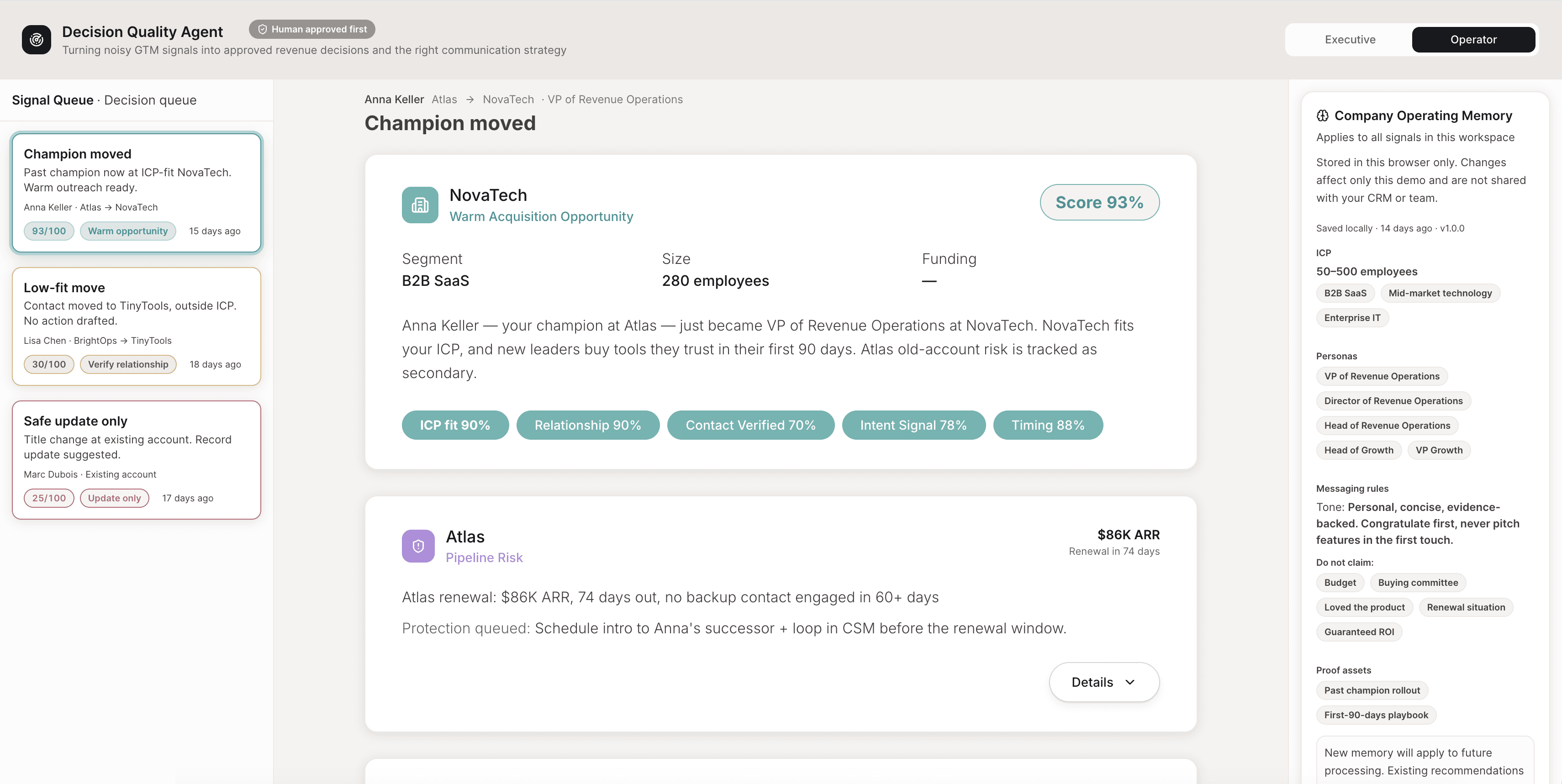
The Decision Quality Agent turns fragmented GTM signals into explainable, human-approved actions, helping revenue teams prioritize opportunities, maintain CRM quality, and continuously improve future decisions.
Every recommendation is supported by transparent reasoning before any action is taken.
Review the proposed action, add business context, and decide whether it should move forward.
Turn approved decisions into faster execution while keeping CRM data accurate and teams focused on high-value opportunities.
Companies invest in helping revenue teams make faster, better-informed decisions on the opportunities that matter most.
This walkthrough follows one real GTM signal from detection to human-approved execution.
Decision-makers receive an explanation before reviewing the supporting analysis.
Every recommendation is backed by evidence and explains how the final score is calculated.
The agent separates verified evidence from unknowns, explains the risk, and recommends the safest next action.
The agent proposes the best communication strategy before generating any customer-facing message.
Approved recommendations become a structured plan defining what to do, when to do it, which channel to use, and what will be created.
Emails, LinkedIn messages, reminders, and CRM tasks are generated only from verified evidence. Nothing customer-facing is executed without human approval.
Approved human feedback becomes reusable business knowledge through Company Operating Memory.
Agent creates drafts, reminders, CRM tasks, and follow-ups while keeping every action traceable.
The feedback is stored as reusable business knowledge to improve future recommendations.
Every reviewed decision helps improve future decision quality through reusable human feedback.
This project started with a simple question:
Rather than automating outreach, I focused on creating transparency, explainability, and confidence before execution begins.